How to Choose a Bedwetting Alarm: A Parent's Buyer's Guide
Wireless or wired? Clip-on or bed pad? Sound, vibration, or both? A comparison table, a 5-point checklist, and the one factor that predicts success.
Quick answer: for most children aged 5–12, the best bedwetting alarm is a wireless one with a clip-on sensor, both sound and vibration, FCC certification, and a discreet watch-style receiver — sold with a return window of at least 60 nights. The reason is simple: the alarm only works if your child wears it every night for 3–5 weeks, and those features are what make kids keep wearing it.
How a bedwetting alarm actually works
Every bedwetting alarm uses the same principle: a moisture sensor sits in or near the underwear, and the instant it detects the first drop, an alarm fires to wake the child. With consistent nightly use, the brain learns to associate the full-bladder feeling with waking — a process called Conditioned Response Training. The hardware's only job is to be reliable and comfortable enough that your child uses it every night without a fight.
Wireless vs. wired vs. bed pad: the comparison
| Wireless clip-on | Wired clip-on | Bed pad / mat | |
|---|---|---|---|
| How it works | Sensor clips to underwear, sends signal to a watch or bedside receiver | Sensor clips to underwear, cable runs up pajamas to a shoulder unit | Sensor mat lies under the sheet |
| Detection speed | First drop | First drop | After a sizeable wet patch — often too late to train |
| Comfort & compliance | High — nothing to tangle, nothing visible | Low–medium — cables tangle, pull out, show under pajamas | High comfort, but child may roll off the mat |
| Sleepover / camp friendly | Yes — looks like a watch | No — visible shoulder box | No — bulky |
| Typical price | $70–$150 | $40–$80 | $60–$120 |
| Best for | Ages 5–12, deep sleepers, self-conscious kids | Tight budgets, very young kids who don't mind cables | Toddlers still in diapers (not ideal for training 5+) |
The single best predictor of bedwetting-alarm success isn't price or brand — it's whether your child willingly wears it every night for 5+ weeks.
Safety certifications to look for
A bedwetting alarm sits on your child's body all night, so certifications matter. Before you buy, confirm the device lists:
- FCC certification — required for any wireless device sold in the US, confirming the radio signal is within safe limits.
- CE marking — the European safety equivalent, a good sign for international brands.
- Low-voltage, battery-powered operation — never anything plugged into wall power while worn.
- BPA-free, skin-safe sensor materials — it's against your child's skin all night.
Bedwetting alarms are behavioral training aids, not medical devices, so they aren't FDA-regulated — but reputable brands voluntarily list the certifications above. If a product page doesn't, treat that as a red flag.
Sound, vibration, or both?
Deep-sleeping kids — which is most kids who wet the bed — need a strong stimulus. Look for all three:
- Loud, variable-tone sound — a single beep is easier to sleep through than a changing pattern.
- Vibration as a pairing or backup — essential for shared bedrooms and for kids who genuinely sleep through sound.
- Volume control — start loud, dial back as your child begins waking on their own.
Sensor type matters more than you'd think
Clip-on sensors attach to the outside of the underwear and fire on the very first drop — exactly what training needs. Pad sensors under the sheet only fire after a substantial wet patch, by which point the bladder has largely emptied and most of the training opportunity is gone. For ages 5+, choose clip-on.
Battery life and night-to-night reliability
Nobody wants to debug an alarm at 2 a.m. Look for rechargeable or easily replaceable batteries, a low-battery indicator, and a stable wireless range (10+ feet covers any bedroom). Read reviews specifically for false-alarm and dropout complaints — those are what make families quit before the method has a chance to work.
Discreetness: what kids will actually wear
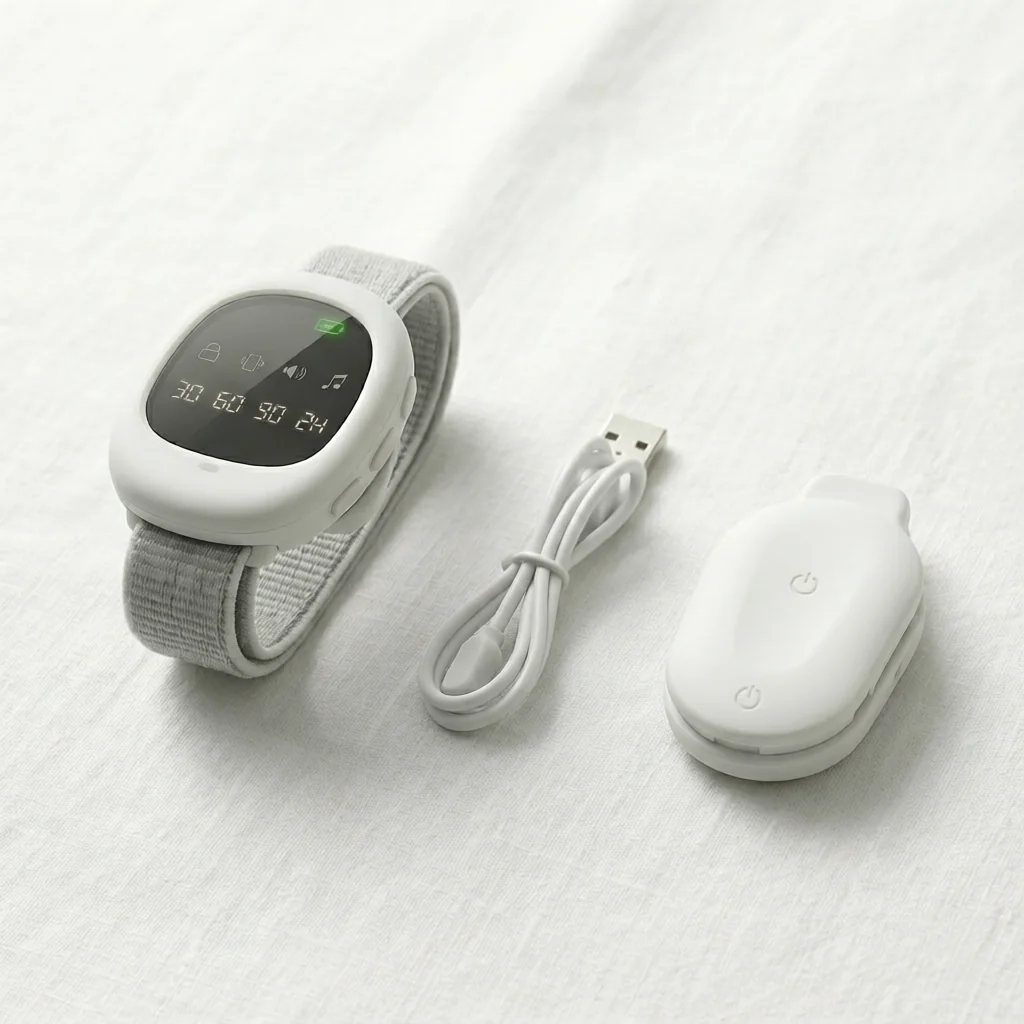
Kids 5+ are old enough to feel embarrassed. A receiver that looks like a normal watch — rather than a clinical unit pinned to the shoulder — makes a real difference in nightly compliance, especially at sleepovers, around siblings, or at grandma's house. If you can't picture your child willingly wearing it every night for 5 weeks, the rest of the spec sheet doesn't matter.
What about price?
Alarms range from about $40 (basic wired) to $150+ (wireless with extras). The cheapest wired models can work, but abandonment is high because of the cable. The priciest units rarely outperform a well-designed mid-range wireless one. And the real cost to weigh isn't the alarm — it's another year of pull-ups (often $40–$60 a month), laundry, and missed sleepovers.
What to skip
- Apps that 'track' bedwetting without a sensor — they don't train anything.
- Mattress-pad-only systems for kids 5+ — too late in the wetting cycle to retrain the response.
- Alarms without a clear return policy — you need 30–60 nights to know if it's working.
- Anything promising results in 'just days' — neuroplasticity takes weeks, full stop.
The 5-point checklist before you buy
- Is it wireless with a clip-on sensor?
- Is it FCC certified?
- Does it offer loud sound + vibration with volume control?
- Is the receiver discreet enough that your child will actually wear it?
- Does the seller offer at least a 60-night money-back guarantee?
Frequently asked questions
What is the best type of bedwetting alarm for a 7-year-old?
A wireless clip-on alarm with a watch-style receiver, sound plus vibration, and FCC certification. At 7, kids are self-conscious enough that a visible wired unit hurts compliance, and clip-on sensors detect the first drop, which is what training requires.
Are wireless bedwetting alarms better than wired?
For most children 5+, yes. They detect wetness just as fast, but with no cable to tangle or show under pajamas, kids wear them more consistently — and consistency is the main predictor of success. Wired alarms are cheaper and can work if your child tolerates the cable.
Do bedwetting alarms work for deep sleepers?
Yes — deep sleep is the main reason children wet the bed, and alarms are designed for it. Choose one with loud, variable-tone sound plus vibration. In the first week a parent usually helps the child wake; within 2–3 weeks most children start responding on their own.
How much should I spend on a bedwetting alarm?
A good wireless alarm costs roughly $70–$150. Spending less usually means a wired unit with higher drop-out rates; spending more rarely improves results. Prioritize a 60-night return policy over extra features.
Are bedwetting alarms safe?
Yes. They're low-voltage, battery-powered behavioral training aids. Look for FCC certification (required for wireless devices in the US) and skin-safe sensor materials. They are not medical devices and involve no medication.
The bottom line
The 'best' bedwetting alarm is the one your child will wear for 35 nights in a row. For most families that means wireless, clip-on, FCC certified, with sound + vibration and a discreet wrist receiver — bought from a seller who gives you enough nights to finish the job. Not sure whether alarms work at all? Read our honest answer on whether bedwetting alarms really work.
LyleCare Bedtime Kit — wireless bedwetting alarm for kids 5+